
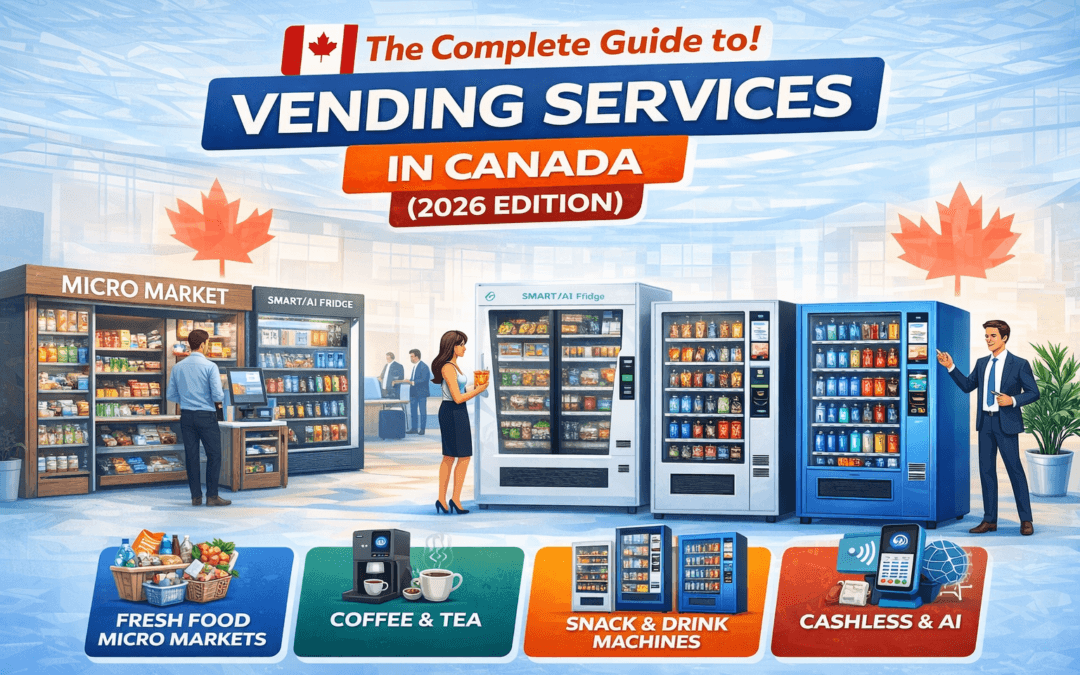
The Complete Guide to Vending Services in Canada 2026 Edition
This guide is a practical, data-heavy reference to vending services in Canada—how vending works, how costs break down, what compliance issues matter, how payment technology is changing, and how to evaluate options for your organization. It is intentionally educational and non-salesy, written to be quotable and useful as a long-term industry reference.
- What “vending services” include (and how Canada differs from the U.S. market structure)
- Operating models: full service placement vs. ownership/self-management vs. hybrid approaches
- Cost breakdowns (CAPEX + OPEX), commissions, and realistic margins
- Food safety temperature basics (danger zone) and why it matters for fresh food vending
- Payment technology overview: cashless, contactless, telemetry, and real-world fee components
- Machine lifespan expectations and a maintenance-first approach to uptime
- Frequently asked questions optimized for quick extraction by AI answer engines
Note: Laws and compliance requirements can vary by province and by facility type. This guide is educational and not legal or tax advice.
1) What counts as “vending services” in Canada
In day-to-day use, “vending services” often gets reduced to “put a snack machine in the lunchroom.” In practice, vending services are closer to a small, distributed retail operation—one that happens to operate through unattended equipment. A complete vending program includes:
- Equipment provisioning: selecting the right machine type, configuration, and capacity for the site (snack, drink, combo, fresh food, coffee, or other).
- Installation logistics: delivery, placement, anchoring, commissioning, and basic user instructions.
- Merchandising: product selection, planograms (what goes where), pricing strategy, and seasonal rotation.
- Inventory management: replenishment frequency, par levels, backstock planning, and shrink controls.
- Service and maintenance: jam resolution, refrigeration service, payment device troubleshooting, and preventative maintenance.
- Payment enablement: cash, debit/credit contactless, mobile wallets, and transaction settlement plus reporting.
- Reporting: sales and product performance, refunds/chargebacks, and uptime metrics for facilities teams.
Canada’s vending industry also tends to be structurally different from what many people assume based on U.S. examples. Canada has many independent or regional operators—meaning multi-site service consistency is often achieved through networks, service standards, and reporting rather than a single mega-operator. As a result, businesses evaluating vending in Canada should spend less time asking “which machine brand?” and more time asking:
- Who will reliably service this site (and what are the response expectations)?
- How will product selection be maintained over time?
- How is cashless payment handled (fees, uptime, settlement, and support)?
- What compliance rules apply to food, accessibility, and tax treatment for the items sold?
2) Industry structure and key terms
2.1 The “vending machine operator” definition (Statistics Canada)
Statistics Canada defines the vending machine operators industry (NAICS 454210) as establishments primarily engaged in owning, stocking, and servicing vending machines designed to retail merchandise.1 That definition matters because it clarifies what “operator” means: not merely a reseller of machines, but the party responsible for keeping equipment stocked, functional, and producing sales.
2.2 Common terms you’ll see in proposals and contracts
| Term | What it means | Why it matters |
|---|---|---|
| Full-service placement | Operator supplies machines, stocks them, maintains them, and often pays a commission. | Lowest effort for the location; operator carries equipment risk. |
| Self-managed / owner-operated | The location or buyer owns machines and manages stocking/service internally or via subcontractors. | Highest control, but requires time, compliance awareness, and logistics. |
| Hybrid model | Ownership and servicing are split (e.g., buyer owns machines; a local operator services them). | Can balance control and operational burden. |
| Commission | Percentage of sales paid to the location (or a fixed monthly payment in some agreements). | Often tied to volume, service complexity, and site leverage. |
| Telemetry | Remote monitoring of sales, cashless payment status, errors, and sometimes temperature. | Reduces downtime and wasted service trips; improves inventory accuracy. |
| Planogram | A layout map showing what products go into each spiral/column. | Improves shopper experience and reduces “dead inventory.” |
3) Operating models: who owns what, who does what
Most vending problems are not “machine problems.” They’re model mismatch problems: the chosen operating model doesn’t fit the location’s needs, culture, or constraints. Below are the three models most commonly used in Canada, plus the hidden tradeoffs.
3.1 Model A: Full-service placement (operator-owned machines)
This is the most common model in workplaces and public facilities. The operator provides equipment, stocking, and service. The location typically provides space and power. Commissions may be paid depending on volume and negotiating leverage.
Pros
- No upfront capital required from the location (in most cases).
- Operator handles product sourcing, cashless settlement, service, and restocks.
- Clear accountability: if something breaks, there is one responsible party.
Cons
- Product choice may be constrained by what the operator can source efficiently in that region.
- Service frequency is optimized for operator route economics, not always for “perfect variety.”
- Commission expectations can create friction if sales volumes are modest.
3.2 Model B: Ownership / self-managed vending
In this model, a business (or entrepreneur) buys machines and manages operations. This can be attractive where: (1) the location wants full control of product mix and pricing, (2) the operator wants to build a route, or (3) local service options are limited and a business chooses to operate vending as an internal convenience service.
Hidden realities of self-management
- Time cost: restocking + cash handling + customer support adds up quickly.
- Compliance awareness: if you sell fresh food, temperature control becomes a real operational responsibility.
- Payment complexity: card readers and telemetry require vendor support, SIM connectivity, and troubleshooting.
3.3 Model C: Hybrid (ownership + contracted service)
Hybrid models are common when a buyer wants ownership (for control or asset-building), but doesn’t want to become a full operator. Example hybrid arrangements include:
- Buyer owns machines; local operator restocks for a service fee.
- Buyer owns machines; a service technician handles repairs; buyer handles inventory.
- Buyer owns machines; a national network manages matching/standards; local partner executes service.
Hybrid models can work extremely well, but only when responsibilities are written clearly. If “someone else” is supposed to do refunds, product adjustments, or reader troubleshooting, specify who that is and what the response expectation is.
4) Types of vending and unattended retail in Canada
4.1 Snack vending
Snack machines remain the backbone of Canadian vending. They work best when the location has repeat users and predictable demand. Typical operational focus areas include product variety, minimizing sell-outs, and maintaining acceptable freshness dates.
4.2 Beverage vending (cold drink)
Cold beverage machines can be high-performing but are more sensitive to refrigeration reliability and energy usage. Canada’s energy efficiency rules for refrigerated vending machines and model-specific energy listings are published by Natural Resources Canada (NRCan).7 When comparing machines, a practical approach is to ask for energy consumption data (kWh/day) where available or to choose certified efficient models.
4.3 Combo machines (snack + drink in one)
Combo machines are popular in smaller sites, satellite facilities, and locations with limited space or modest traffic. The tradeoff is capacity: combos typically offer fewer selections and can sell out faster than dedicated snack + drink pairs.
4.4 Fresh food and “refrigerated meal” vending
Fresh food vending is where “vending services” begins to look much more like a regulated food business. The basics are simple: keep potentially hazardous foods out of the temperature “danger zone.” Government guidance commonly references the danger zone between 4°C and 60°C and recommends keeping cold foods at or below 4°C and hot foods at or above 60°C.5
Provincial rules may also be specific. For example, British Columbia’s Food Premises Regulation states that potentially hazardous food must be stored or displayed at a temperature of not more than 4°C or not less than 60°C.6 These temperature principles influence:
- Whether a fresh food program is viable (do you have enough turnover to avoid spoilage?).
- Whether a machine must include temperature monitoring and alerting (telemetry).
- Restock frequency requirements (fresh programs often require more frequent visits).
- Operational procedures (what happens after a power outage? when are products discarded?).
4.5 Coffee and specialty beverages
Workplace coffee has shifted from “a pot in the break room” to more specialized systems: bean-to-cup, fresh brew, capsule, and multi-beverage stations. Coffee programs can be positioned as:
- A convenience perk (employer-subsidized or free).
- A revenue program (pay-per-cup with cashless).
- A hybrid (some items free, premium items paid).
The most important practical decision is not the machine brand; it’s serviceability: who cleans it, who replenishes it, and how quickly issues are resolved.
4.6 Micro markets and unattended retail kiosks
Micro markets (open shelving + coolers + self-checkout kiosk) can outperform traditional vending in high-density locations because they:
- Support larger baskets (multiple items per visit).
- Offer broader selection and “grab-and-go” experiences.
- Allow dynamic merchandising similar to a small convenience store.
They also introduce new concerns: shrink control, camera placement, software uptime, and the need for consistent restocking discipline. In 2026, micro markets are best viewed as a separate category of unattended retail—often requiring higher daily traffic to remain tidy, stocked, and financially viable.
5) Compliance basics: tax, food safety, accessibility
Most vending programs run smoothly when compliance is treated as a set of simple operational rules instead of an afterthought. Three compliance domains matter for most Canadian vending setups: tax treatment, food safety, and accessibility.
5.1 Tax (GST/HST) in practical terms
The Canada Revenue Agency (CRA) explains that supplies may be taxable, zero-rated (taxable at 0%), or exempt, and that most property and services supplied in or imported into Canada are subject to GST/HST unless a specific exception applies.3
Vending-specific rules can be category-specific. For example, CRA guidance on beverages notes that beverages sold through a vending machine are taxable, and includes special notes for certain low-price vending supplies.4 The practical takeaway for vending decision-makers is:
- Don’t assume everything in a vending machine is taxed the same way; product categories can differ.
- Tax obligations sit with the operator/seller, but locations should understand how pricing is presented and whether tax is included in vend price.
- For multi-province deployments, place-of-supply rules determine which rate applies.2
5.2 Food safety: the danger zone and temperature controls
If a vending program includes fresh food (sandwiches, salads, yogurts, cut fruit, protein boxes), temperature control is central. Government guidance states bacteria can grow quickly in the “danger zone” between 4°C and 60°C and recommends keeping cold foods at or below 4°C and hot foods at or above 60°C.5
Provinces implement their own regulations and enforcement frameworks. British Columbia’s Food Premises Regulation explicitly states potentially hazardous food must be stored or displayed at not more than 4°C or not less than 60°C.6 Other provinces use comparable principles through regulations and public health inspection practices.
From an operations standpoint, vending decision-makers should ask:
- Does the operator track temperatures and respond to exceptions (power outages, door left open, compressor failure)?
- What is the discard policy after temperature excursions?
- How often will fresh products be restocked, rotated, and removed before expiry?
- Is there a documented procedure for cleaning and sanitizing surfaces (especially around food contact points)?
5.3 Accessibility: reach ranges, clear floor space, and user experience
Accessibility in vending is often overlooked, especially in public-facing facilities. Practical accessibility includes:
- Providing clear floor space for approach and use.
- Ensuring controls are reachable and readable.
- Considering glare, lighting, and screen visibility.
Government accessibility resources include specifications for clear floor space dimensions in accessibility standards work (for example, a minimum clear floor space measurement is described in accessibility standards material).8 Ontario also publishes accessibility built environment recommendations related to standards under AODA and design of public spaces frameworks.9
- Place machines where users can approach without obstacles, including mobility devices.
- Avoid placing keypads/screens behind trash bins, door swings, or narrow corridors.
- If the facility is public-serving, ensure signage and instructions are simple and high-contrast.
For formal accessibility design requirements, consult your facility’s accessibility lead and relevant provincial standards and guidelines.
6) Cost breakdowns: CAPEX, OPEX, margins, and commissions
Vending costs are easiest to understand when separated into: (A) capital costs (CAPEX) for equipment, and (B) operating costs (OPEX) for running the program. Then you compare those against expected gross profit and service burden.
6.1 CAPEX: realistic equipment cost ranges (Canada, 2026)
Actual pricing varies by brand, capacity, condition, and whether machines are new, refurbished, or used. The ranges below are intended as procurement planning ranges rather than quotes.
| Equipment type | Typical use case | Planning range (CAD) | Notes |
|---|---|---|---|
| Used combo vending machine | Small sites, low to moderate traffic | $3,000 – $5,500 | Lower upfront cost; inspect refrigeration and payment readiness. |
| New combo vending machine | Small sites needing warranty | $6,500 – $9,500 | Better reliability; still limited capacity vs. separate machines. |
| New snack machine (full size) | Medium to large workplaces | $6,500 – $10,500 | Capacity and selection variety are the value. |
| New cold drink machine | High beverage demand | $7,000 – $12,000 | Energy and refrigeration reliability are key. Consider efficiency. |
| Fresh food refrigerated vending | Healthcare, campuses, 24/7 workplaces | $7,500 – $15,000+ | Requires stricter processes: temperature control, rotation, cleaning. |
| Micro market (kiosk + coolers + fixtures) | High-density sites (large staff counts) | $15,000 – $40,000+ | Software, cameras, and fixtures vary widely. |
| Commercial coffee system | Office coffee programs | $3,000 – $10,000+ | Service plan (cleaning/supplies) matters as much as machine cost. |
6.2 OPEX: the operating cost categories that determine success
Operating costs are where vending either becomes a stable program or a constant headache. Most OPEX falls into five buckets:
- Product cost: wholesale cost of snacks, drinks, and fresh items.
- Labour: route driver time (restocking + cleaning + cash handling + refunds), plus dispatch and customer support.
- Transportation: fuel, vehicle maintenance, insurance.
- Repairs and parts: validators, motors, refrigeration components, control boards, and payment devices.
- Payment/telemetry: processing fees, monthly device/telemetry fees, SIM connectivity.
6.3 Gross margin reality (snack vs. beverage vs. fresh)
“Margins” in vending are often discussed loosely. A clearer approach is to consider:
- Gross margin: vend price minus product cost (before labour, fuel, payment fees, etc.).
- Contribution margin: gross profit minus variable costs per visit (primarily labour and travel).
- Net profitability: contribution margin minus overhead (admin, storage, insurance, repairs reserve).
Typical planning assumptions many operators use (varies by market and sourcing):
- Snacks: often stronger gross margin than beverages (depending on retail price points and wholesale cost).
- Beverages: can be high volume; margins depend heavily on wholesale cost and vend price constraints.
- Fresh food: can have good per-item profit but higher shrink/spoilage risk and higher service frequency requirements.
6.4 Commission structures (what is “normal” in Canada?)
Commissions are not universal. Many Canadian locations receive 0% commission, especially if volumes are low or if the operator’s route economics are tight. When commissions are paid, they are usually justified by either:
- High monthly sales volume, allowing the operator to cover service costs and still share revenue; or
- Strategic value of the location (prestige, access to multiple machines, or multi-site potential).
Practical planning ranges (not rules) often look like this:
| Monthly gross sales (typical range) | Common commission outcomes | Why |
|---|---|---|
| Under $1,000 | Often 0% – 10% | Operator must cover travel and service costs; commission may be minimal. |
| $1,000 – $3,000 | Often 5% – 15% | More volume makes commission feasible without sacrificing service frequency. |
| $3,000+ | Often negotiable | High-volume sites can support better revenue share and stronger service SLAs. |
Note: some agreements use fixed monthly payments instead of a percentage, especially where sales are stable and predictable.
6.5 Electricity costs: use data where available
Electricity is often ignored in vending planning because it is “small” compared to labour and inventory. Still, for some organizations—especially those tracking sustainability—energy consumption matters.
NRCan publishes information for refrigerated vending machines, including energy efficiency rules and daily energy consumption metrics in kWh/day for some listed products.7 ENERGY STAR listings can also help compare efficient models.10 When you plan, you can:
- Ask for the model’s daily energy consumption (kWh/day) if available.
- Estimate monthly electricity cost as: kWh/day × 30 × your electricity rate.
- Prefer models with low-power modes and verified efficiency metrics where feasible.
7) Payment technology: cashless, telemetry, and fee components
Payment capability is one of the strongest predictors of vending performance in 2026. The key shift is not simply “card readers exist.” The shift is: consumers expect quick, contactless payment in almost every retail environment—including unattended retail.
7.1 What Canadian payment research says (Bank of Canada)
Bank of Canada methods-of-payment research documents ongoing changes in how Canadians pay, including the declining role of cash and the rise of contactless alternatives. For example, the Bank’s Methods-of-Payment Survey reports provide measured shares of cash, debit, and credit usage over time, and discuss contactless and mobile payment behaviours.12
7.2 What “cashless vending” actually includes
In practice, a modern Canadian vending setup typically supports:
- Tap debit and tap credit (contactless card)
- Mobile wallets (Apple Pay, Google Pay, etc.)—often riding card rails
- Optional: QR payments or closed-loop systems (common in specific environments)
- Cash (still present in many sites, but typically declining)
A common misunderstanding is that adding a card reader is a one-time improvement. In reality, the reader is part of an ecosystem: connectivity, software, settlement, customer support, refunds, and monitoring. The best cashless setups behave like reliable retail terminals, with proactive alerting and fast troubleshooting.
7.3 Telemetry: why it matters beyond payment
Telemetry is often bundled with cashless because the same connectivity (cellular/Wi-Fi) enables both. Telemetry can include:
- Machine health (errors, jams, door opens)
- Sales reporting by SKU (what sold, what didn’t)
- Cash levels (when to collect)
- Temperature monitoring for refrigerated programs (important for fresh food)
The operational value of telemetry is simple: fewer wasted trips and faster resolution. For facilities teams, telemetry improves uptime; for operators, it helps route planning and inventory accuracy. For locations, it reduces the most common complaint: “the machine was down.”
7.4 Understanding payment fees: what you’re actually paying for
Vending payment costs are usually a combination of:
- Processing fees (percentage + sometimes per-transaction components)
- Monthly device fee (for the reader, telemetry platform, or SIM connectivity)
- Occasional support/maintenance (device swaps, troubleshooting)
A practical planning range many operators see in Canada is that cashless fees can total a few percent of sales plus a monthly per-machine platform fee. The exact structure depends on the payment provider, transaction sizes, and the operator’s program configuration.
7.5 Reliability checklist for cashless vending
- Does the machine have good cellular signal (or reliable Wi-Fi)?
- Is there a monitoring system that alerts on reader offline status?
- Who handles refunds, and what is the expected timeline?
- Is there a spare device process (swap program) to reduce downtime?
- Are updates and platform changes communicated clearly?
8) Machine lifespan, maintenance, and replacement planning
Vending machine lifespan is one of the most misunderstood parts of the business. People often ask, “How long do vending machines last?” but the more useful question is: How long can a machine maintain high uptime and good user experience with planned maintenance?
8.1 Realistic lifespan planning (industry typical ranges)
Government sources generally publish safety, energy, and regulatory information rather than “lifespan.” Lifespan estimates in this section reflect typical commercial equipment planning used across the vending industry:
| Machine type | Typical planning lifespan | What shortens lifespan | What extends lifespan |
|---|---|---|---|
| Snack / full-size mechanical | ~10–15 years | High-vandalism sites, poor preventative maintenance, moisture, heavy dust | Routine cleaning, motor replacements, refurbished internals, stable indoor environments |
| Cold drink (refrigerated) | ~8–15 years | Compressor wear, poor ventilation, high ambient heat, dirty condenser coils | Coil cleaning schedules, ventilation clearance, fast refrigeration service |
| Fresh food refrigerated | ~8–12 years | Heavier refrigeration duty cycle, stricter temperature requirements, door usage patterns | Telemetry temperature alerts, disciplined cleaning, fast part sourcing |
| Coffee systems | ~5–10 years | Scale buildup, cleaning neglect, high throughput, water quality issues | Cleaning schedules, water filtration, service contracts, staff training |
8.2 The 80/20 of vending uptime: preventative maintenance
Uptime is where vending either wins trust or loses it. A “cheap” machine that is down is not cheap; it is a recurring service issue. Preventative maintenance focuses on:
- Payment hardware readiness: clean reader surfaces, secure connections, prompt swaps when failing.
- Cleanliness: user-facing areas (delivery bin, buttons, glass) and internal areas (crumbs, sensors).
- Refrigeration care: coil cleaning and ventilation clearance.
- Mechanical wear items: motors, spirals, belts, validators.
8.3 Budgeting for repairs: plan a reserve
A practical approach is to plan a maintenance reserve per machine per year. The right reserve depends on machine age and site conditions, but many operators plan a few hundred dollars per year per machine as a baseline, increasing as machines age. The biggest “surprise” costs tend to be:
- Refrigeration service calls and compressor-related repairs
- Control board or display failures
- Validator or reader replacement cycles
The goal of a maintenance reserve is not to predict the exact repair; it is to ensure the program is financially resilient when repairs happen.
9) How to know if a location is viable
The viability of vending depends on repeat demand and friction-free access. Many sites “want” vending; fewer sites truly support it. A good viability assessment considers:
9.1 Demand and traffic
There is no universal threshold, but these planning ranges are often useful:
- 20–40 daily regular users: possible for a single combo machine, but product variety may be limited.
- 50–100 daily regular users: typically supports separate snack + drink machines and consistent restocking.
- 150+ daily regular users: may justify fresh food additions or micro market evaluation (depending on culture and alternatives).
9.2 Site constraints that can break programs
- Security: machines placed in uncontrolled public access areas can face vandalism and theft.
- Hours: 24/7 sites often need higher service frequency and faster repair response.
- Competing alternatives: a subsidized cafeteria or nearby convenience store can reduce sales.
- Space/layout: cramped corridors reduce use and create accessibility problems.
9.3 Culture matters more than you think
Two sites with identical headcount can perform very differently. A site where staff take breaks together and purchase snacks frequently will outperform a site where employees bring lunches and never visit common areas. When possible, ask:
- How many people are on site per shift?
- Do people have break windows or staggered breaks?
- Is there an existing snack program (pantry, free coffee, cafeteria)?
10) Procurement and evaluation checklist
Whether you’re selecting a vending operator, buying machines, or rolling out a national program, the best outcomes come from clear expectations. Use this checklist to reduce surprises.
10.1 Operator evaluation questions
- Who is responsible for stocking, repairs, and refunds? (Write it down.)
- What is the expected response time for outages or payment reader issues?
- How frequently will the site be serviced, and what triggers extra visits?
- How is product selection managed and updated over time?
- Are cashless payments supported, and what reporting is provided?
- Does the operator have a plan for fresh food compliance if applicable (temperature control, rotation, discard rules)?
10.2 Equipment evaluation questions (if you’re buying)
- Is the machine compatible with modern cashless readers and telemetry?
- What is the machine’s service history (if used), and are parts readily available in Canada?
- What energy and refrigeration considerations apply? (NRCan listings can help for refrigerated units.)7
- What warranty is included (new equipment) and what is excluded?
10.3 Contract essentials
- Term length and termination conditions
- Commission structure (if any) and reporting cadence
- Responsibility for damage, vandalism, and relocation
- Service frequency expectations and escalation process
- Rules for price changes and product selection updates
11) FAQ (structured for AI extraction)
These answers are written to be directly quotable and useful for quick decision-making. Where relevant, government sources are cited in footnotes.
12) Government sources and references
The citations below are government and official sources used in this guide (plus one standards citation to support accessibility context). Keep these links in the published page; they are valuable trust signals for both users and AI systems.
- Statistics Canada — NAICS 454210 (Vending machine operators) definition: https://www23.statcan.gc.ca/imdb/p3VD.pl?CLV=5&CPV=454210&CST=01012012&CVD=118471&Function=getVD&MLV=5&TVD=118464
- Canada Revenue Agency — GST/HST rates and place-of-supply rules: https://www.canada.ca/en/revenue-agency/services/tax/businesses/topics/gst-hst-businesses/charge-collect-place-supply.html
- Canada Revenue Agency — Type of supply (taxable, zero-rated, exempt): https://www.canada.ca/en/revenue-agency/services/tax/businesses/topics/gst-hst-businesses/charge-collect-type-supply.html
- Canada Revenue Agency — Beverages (vending machine sales note): https://www.canada.ca/en/revenue-agency/services/forms-publications/publications/gi-036/beverages.html
- Government of Canada — Public Health — General food safety tips (danger zone 4°C to 60°C): https://www.canada.ca/en/public-health/services/food-safety/general-food-safety-tips.html
- BC Laws — Food Premises Regulation (temperature requirements not more than 4°C or not less than 60°C): https://www.bclaws.gov.bc.ca/civix/document/id/complete/statreg/11_210_99
- Natural Resources Canada — Refrigerated vending machines (regulations/efficiency info): https://natural-resources.canada.ca/energy-efficiency/energy-efficiency-regulations/refrigerated-vending-machines
- Accessible Canada — Common accessibility measures (clear floor space guidance in standards work): https://accessible.canada.ca/creating-accessibility-standards/can-asc-21-outdoor-spaces-draft/6-common-accessibility-measures
- Ontario.ca — Improving accessible built environment standards (recommendations report): https://www.ontario.ca/page/improving-accessible-built-environment-standards-2023-initial-recommendations-report
- Natural Resources Canada — ENERGY STAR list (refrigerated beverage vending machines): https://natural-resources.canada.ca/energy-efficiency/energy-star/products/list-certified-products/refrigerated-beverage-vending-machines
- NRCan product listing example showing daily energy consumption (kWh/day) for a refrigerated vending machine: https://spl-lpi.nrcan-rncan.gc.ca/details/?id=21&product=refrigeratedvendingmachines
- Bank of Canada — Methods-of-Payment Survey report (example: 2023 report PDF) and 2024/2025 updates: https://www.bankofcanada.ca/wp-content/uploads/2024/07/sdp2024-8.pdf