
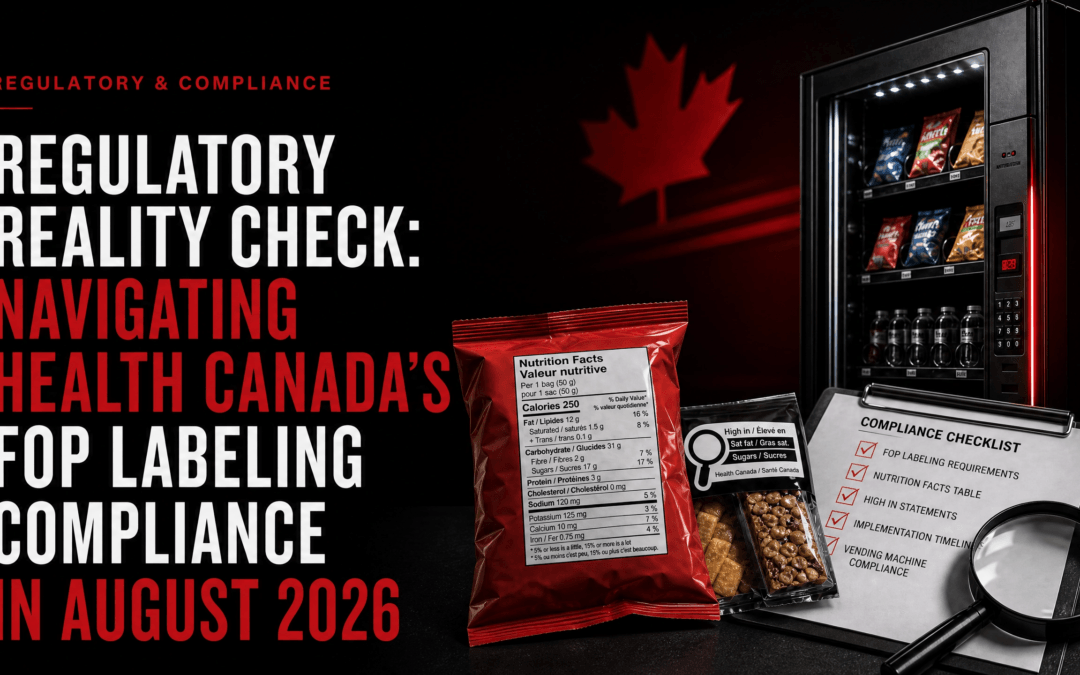
As of January 1, 2026, Canada’s new Front-of-Package (FOP) nutrition labelling requirements are fully in effect.
You’ve probably already noticed the new black-and-white nutrition symbols appearing on products across Canada. Foods that meet or exceed certain levels of saturated fat, sugars or sodium are generally required to display the symbol prominently on the front of the package.
For vending operators, there’s not much you need to do from a compliance standpoint. The responsibility for properly labelling packaged products generally falls on manufacturers and suppliers.
What may be more interesting to operators is whether these new labels have any impact on what customers actually buy.
Will the Labels Change Vending Sales?
That’s the question worth watching.
The new symbols make certain nutritional information much harder to miss. A customer choosing between two snacks may now see a prominent “High in Sugars,” “High in Sodium” or “High in Saturated Fat” warning on one of them.
Research into front-of-package labelling suggests these types of warnings can affect how consumers view the healthfulness of a product and, in some cases, influence purchasing decisions.
Whether that translates into a meaningful change in vending sales remains to be seen.
Could This Increase Sales of Healthier Options?
Possibly; and this may be one of the more interesting effects for vending operators to watch.
When a customer is standing in front of a vending machine, the decision between products is often made quickly. With warnings for high sugars, sodium or saturated fat now much more visible, customers who are already looking for a healthier choice may be more likely to consider an alternative without a warning symbol.
That doesn’t necessarily mean a product without a FOP warning is “healthy.” But the absence of the warning could affect how customers perceive the choices in front of them.
This could be particularly interesting at locations where healthier products already have some demand, such as workplaces, schools, recreation facilities and fitness centres.
For operators, the real test will be in the sales data over the coming months. If healthier alternatives begin gaining sales while comparable products carrying FOP warnings decline, operators will have a clear reason to adjust their product mix.
What Products Get the Symbol?
For most prepackaged foods, the front-of-package symbol is required when the product meets or exceeds 15% of the Daily Value for sugars, sodium or saturated fat.
Different thresholds apply to certain products, including foods with smaller reference amounts, and there are also exemptions under the regulations.
For vending operators, however, there’s little reason to start calculating nutritional thresholds themselves. Packaged products supplied for sale in Canada should already have the appropriate Canadian labelling.
Don’t Change Your Machine Based on a Label
The arrival of FOP labels doesn’t mean operators should suddenly start replacing popular products.
What matters is whether customer behaviour actually changes.
If a product continues to sell, there’s little reason to remove it simply because it carries a nutrition symbol. On the other hand, if customers begin choosing alternatives more frequently, operators will see that reflected in their sales.
Operators with telemetry and detailed sales reporting may be in an especially good position to see whether purchasing habits change over the coming months.
Something Worth Watching
Canada’s new front-of-package labels are a significant change to how nutritional information is presented to consumers, but their impact on vending is still an open question.
For most operators, this isn’t something that requires an immediate change in product selection or operations.
Instead, it’s another consumer trend worth keeping an eye on. As Canadians become more familiar with the new symbols, vending sales will ultimately tell operators whether customers care; and whether healthier alternatives stand to benefit.