
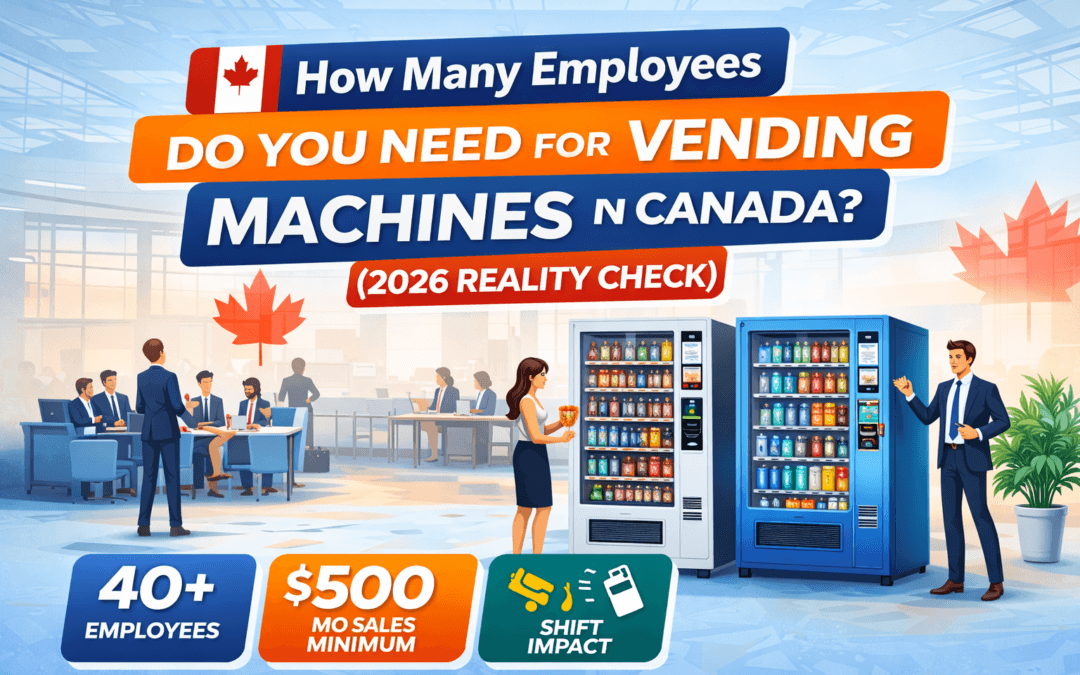
Employee count matters—but it’s not the only factor. This guide shares practical Canadian thresholds for vending viability, including foot traffic, shift impact, sales minimums, commission expectations, timelines, and FAQs.
- $500/month gross sales is a common minimum performance target for a sustainable vending location.
- 40 employees can work, but foot traffic, shift mix, and nearby food options often matter more than headcount.
- Evening staff often buy ~1.5× more than day staff; night staff can buy ~2× more.
- 75–150 employees is usually a strong range for separate snack + drink machines.
- 150+ employees is typically the sweet spot for fresh food and coffee without subsidies.
- Under 30 employees: usually not viable unless there’s meaningful visitor/public foot traffic.
- 40 employees: borderline viable if nearby food options are limited and demand is consistent.
- 50–75 employees: typically stable for a combo or small snack + drink program.
- 75–150 employees: strong performance range for snack + drink machines.
- 150+ employees: fresh food and coffee services become realistic without subsidies.
- 100+ daily users: micro market discussions become realistic (depending on site factors).
1) Why 40 employees can work (and why it sometimes fails)
In Canadian vending, 40 employees is often where vending can start to make sense—but it’s not guaranteed. The biggest mistake is assuming a headcount threshold automatically creates sales.
What matters most is the total number of daily users who will pass the machine and choose it over other options. Employee count helps, but so can outside foot traffic.
Common factors that can make a 40-person office underperform:
- Convenient nearby restaurants or coffee shops
- Staff consistently bringing lunch and snacks
- Free snack/drink programs already provided by the employer
- Low use of common areas (people don’t pass the machine)
2) The real industry floor: $500/month gross sales
A practical rule used by many operators across Canada is to keep machines at a minimum of about $500/month in gross sales. Below that level, service becomes inefficient and long-term reliability can suffer.
If a location consistently generates less than $500/month, it may be better suited for a different approach (for example, purchasing and managing a machine internally), depending on the organization’s goals.
3) The “sweet spot” employee ranges
Every location is different, but the ranges below reflect common real-world patterns across Canada.
| Employees / daily users | Typical outcome | What usually works best |
|---|---|---|
| 25–40 | Borderline (depends on traffic) | Combo machine or limited setup; viability improves with visitor traffic and shift work. |
| 40–60 | Stable | Combo or small snack + drink program, especially where food alternatives are limited. |
| 75–150 | Strong | Separate snack + drink machines; better variety, fewer sell-outs, more consistent service. |
| 150+ | Very strong | Fresh food and coffee services become viable without subsidies; higher service frequency is justified. |
| 100+ daily users | Micro market discussion | Depends on culture, security, and layout; smart/AI solutions may lower thresholds over time. |
4) Shift structure: the hidden multiplier
Shift mix can matter as much as headcount. In many workplaces, day staff purchase less on average than evening and night staff. A smaller site with heavier evening/night usage can outperform a larger 9–5 office.
- Evening staff: ~1.5× the purchasing of day staff
- Night staff: ~2× the purchasing of day staff
This is why some 30-person facilities can qualify—if a large share of staff are evenings and nights.
5) When fresh food makes sense
Fresh food programs can be valuable, but they introduce higher complexity: tighter product rotation, more frequent service needs, and spoilage risk. In practice, fresh food usually becomes viable without subsidies at around 150+ employees.
Below that, fresh programs may still be possible, but many locations choose to subsidize offerings to help offset wastage and service costs.
6) When a micro market becomes viable
Micro markets typically require consistent daily use and strong inventory turnover. Historically, they were suited to larger workplaces, but smart/AI solutions (like glass-front fridges) are changing the market.
As a practical starting point, micro market discussions often begin around 100+ regular daily users, depending on the site.
7) When you should NOT install vending
Sometimes the best decision is to pause or avoid vending—especially if the location won’t support sustainable service.
Top reasons to rethink vending:
- Not enough staff or traffic: If you can’t realistically hit about $500/month in sales, long-term service quality may suffer.
- Free food program already exists: If the company provides free snacks/drinks, paid vending may underperform. In some cases, buying and self-managing a machine makes more sense.
- Poor vendor standards: Some vendors place old, poorly maintained machines at “throwaway” locations and neglect restocking/repairs. Choosing reputable service standards is essential.
8) Commission expectations by sales volume
Commission is usually tied to performance. As sales increase, there is more room to share revenue while maintaining strong service.
| Monthly gross sales | Typical commission outcome | Why |
|---|---|---|
| Under $500 | Usually none | Low volume limits service economics and margin for revenue sharing. |
| $1,000+ | 5–10% often possible | More sales support better service frequency and a modest location share. |
| $2,500+ | 10%+ often negotiable | High-performing sites can support stronger commissions and more robust service. |
Note: locations that demand the highest commission immediately can unintentionally create poor service outcomes. Performance-based increases often align incentives better.
9) Typical installation timelines
After approval, standard vending installations are typically around 2 weeks, but timing depends on machine availability and site complexity.
- Standard vending: ~2 weeks
- Micro markets: 3–4+ weeks (sometimes longer for substantial installs)
- Shorter or longer timelines: possible depending on equipment availability and site constraints
10) Common frustrations with vending providers
Many businesses switch vending providers for the same reasons:
- Machines not being refilled
- Broken machines left unattended
- Providers not responding to calls or emails
- Product requests ignored
- In extreme cases: vendors disappearing or abandoning machines
FAQ
If you manage multiple locations across Canada, it can also help to work with a service that can apply consistent standards and reporting across regions.
© 2026 Vending Canada. Educational content. Availability and service standards vary by region and facility type.