
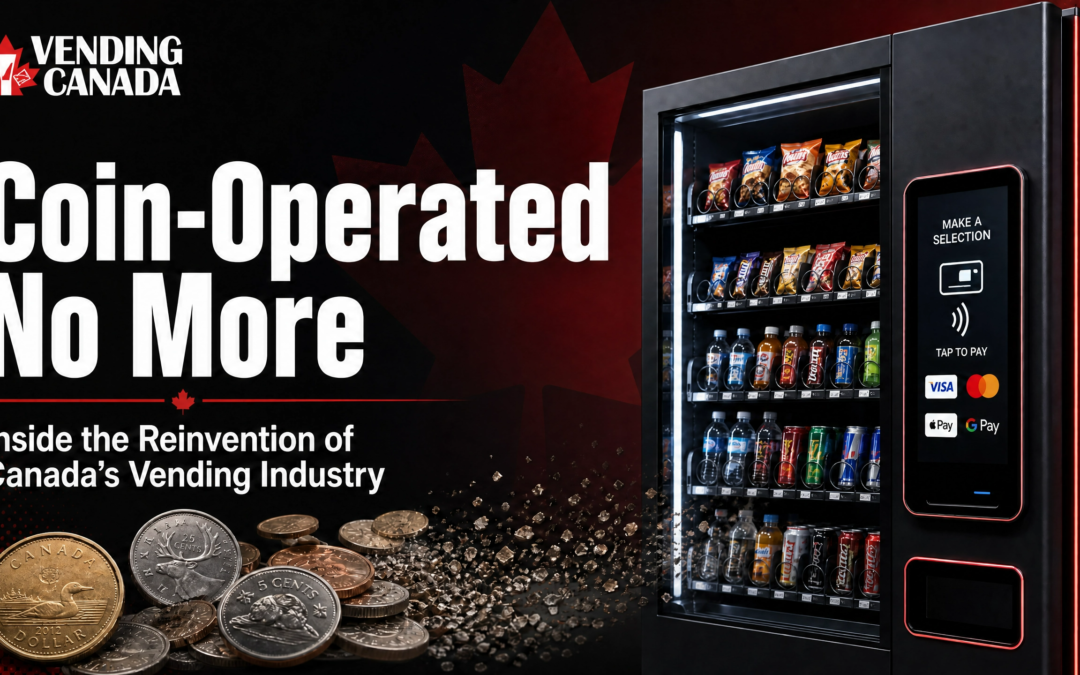
For decades, Canada’s vending machines were a familiar part of office break rooms, schools, hospitals, and public buildings. They accepted quarters, dispensed chips, chocolate bars, and cans of pop, and required little thought from either operators or customers.
That business model is under increasing pressure in 2026. The operators finding success today are not waiting for demand to return. Instead, they are rethinking how unattended retail works.
A Shrinking Footprint, A Changing Business
According to industry research firm IBISWorld, Canada’s vending machine operators sector (NAICS 45421CA) is expected to generate approximately $223.3 million in revenue in 2026, with about 756 businesses operating across the country. The market has contracted (due to covid, remote work) at a compound annual rate of roughly 5.3% since 2021, although 2026 has seen a modest 1% rebound. Aramark Corporation continues to be the industry’s largest participant, combining vending operations with its broader food service business.
The challenges facing traditional vending operators are structural rather than temporary. Hybrid and remote work have reduced foot traffic in office buildings and institutions that once generated steady vending sales. Online shopping has shifted many impulse purchases away from physical machines, while cost-conscious consumers increasingly buy snacks and drinks from grocery stores instead of paying vending prices. As more employers encourage or require employees to return to the workplace, increased office attendance could provide some support for vending demand, although it is unlikely to fully offset the longer-term structural changes affecting the industry.
At the same time, consumer preferences are changing. More Canadians are willing to spend extra on products they consider healthier, premium, organic, or environmentally sustainable. Those categories have historically been underrepresented in conventional vending machines, creating opportunities for operators willing to adapt. However, demand for healthier products in vending machines has generally remained limited. While consumers often express interest in healthier options, purchasing behaviour has not consistently matched that interest, with traditional snacks and beverages continuing to account for most vending sales.
The Technology Behind the Shift
Much of this transformation is supported by specialized technology providers.
A significant contributor to this technological shift is MONEXgroup, a provider of comprehensive self-serve unattended payment solutions. Their offerings, such as PayPro, PayPro Max, and PayQR, are designed for flexibility and reliability, supporting all payment types and integrating seamlessly into various self-serve environments, including vending, micro-markets, car washes, parking, EV charging, and laundry services. MONEXgroup’s platforms, such as Tap & Wash® and Scan & Wash™, enable secure, efficient, and user-friendly experiences that drive revenue and reduce operational overhead.
MONEXgroup emphasizes the importance of flexible payment solutions that support both traditional vending and micro-market models, providing operators with tools for inventory management, real-time sales data, and adaptability to customer behavior. The company’s integrated payment solutions encompass unattended vending and self-service, in-store POS, on-the-go, and e-commerce, all backed by 24/7/365 support and comprehensive reporting dashboards. This holistic approach allows businesses to consolidate their payment processing under a single provider, simplifying operations and maximizing efficiency.
Where This Leaves Operators
Canada’s vending industry continues to change as consumer preferences, workplace environments, and technology evolve. Operators that adapt to these changes by improving their product mix, payment options, and overall customer experience will be better positioned to remain competitive.
While traditional vending remains an important part of the industry, continued growth will come from meeting changing customer expectations and responding to market demand.