
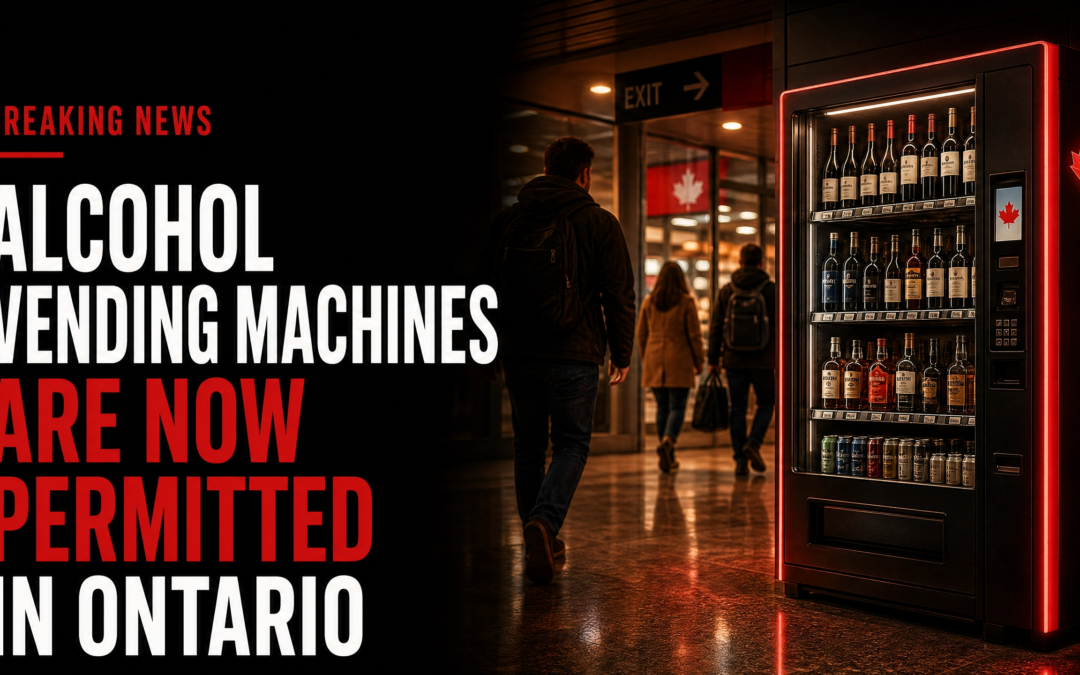
A new regulatory change could have implications for the future of smart and controlled vending.
Ontario’s vending industry has a new development to watch.
Effective September 8, 2026, Ontario has introduced rules allowing liquor vending machines within establishments that hold a Liquor Sales License, subject to requirements established by the Alcohol and Gaming Commission of Ontario (AGCO).
The change comes through updates to the AGCO Registrar’s Standards. The previous prohibition relating to liquor vending machines under Standard 5.11 has been removed, while Standard 5.16 establishes new requirements for licensees intending to use liquor vending machines within their licensed establishments.
For Canada’s vending industry, this is an important regulatory development because it creates a specific framework for vending technology to be used in connection with the sale of alcohol. Industry experts say this is a step in the right direction towards ID verification vending. For now, an attendant is still required to verify ID & make sure guidelines are followed
What the New Rules Say
The new framework does not create a system of completely unattended alcohol vending.
Instead, liquor vending machines are permitted within liquor-sales-licensed establishments under specific conditions.
The requirements include:
- The vending machine must be located within the liquor-sales-licensed establishment.
- The licensee remains responsible for complying with applicable requirements relating to liquor sales and service.
- The licensee must notify the AGCO before using a liquor vending machine.
- The vending machine must be continuously supervised or controlled by staff of the licensed establishment.
- The machine may dispense single servings.
- Permitted products include beer, cider, wine and ready-to-drink alcoholic beverages.
- Spirits are not included among the permitted liquor products for vending machines.
- The vending machine is intended specifically for the permitted liquor products and cannot also be used to vend non-alcoholic beverages or unrelated products.
These requirements are important because the change is not simply an authorization for operators to install an unsupervised alcohol machine anywhere.
The licensed establishment and its staff continue to have responsibilities under the regulatory framework.
A Development Worth Watching
Ontario’s September 2026 regulatory change does not mean that fully autonomous alcohol vending is now permitted.
It does, however, establish a clear framework for liquor vending machines within licensed establishments, with specific controls and responsibilities.
For Canada’s vending community, that makes this more than an alcohol-industry story.
It is another example of how vending technology and regulation are beginning to intersect in new ways.
And while nobody can say what the next regulatory step will be, one question is likely to remain on the industry’s radar:
Could smarter verification technology eventually make more regulated forms of vending possible?
For now, Ontario’s answer is controlled vending ; with staff supervision still firmly part of the equation.
Vending Canada will continue to monitor regulatory developments that could affect vending operators, machine manufacturers and unattended retail businesses across Canada.